

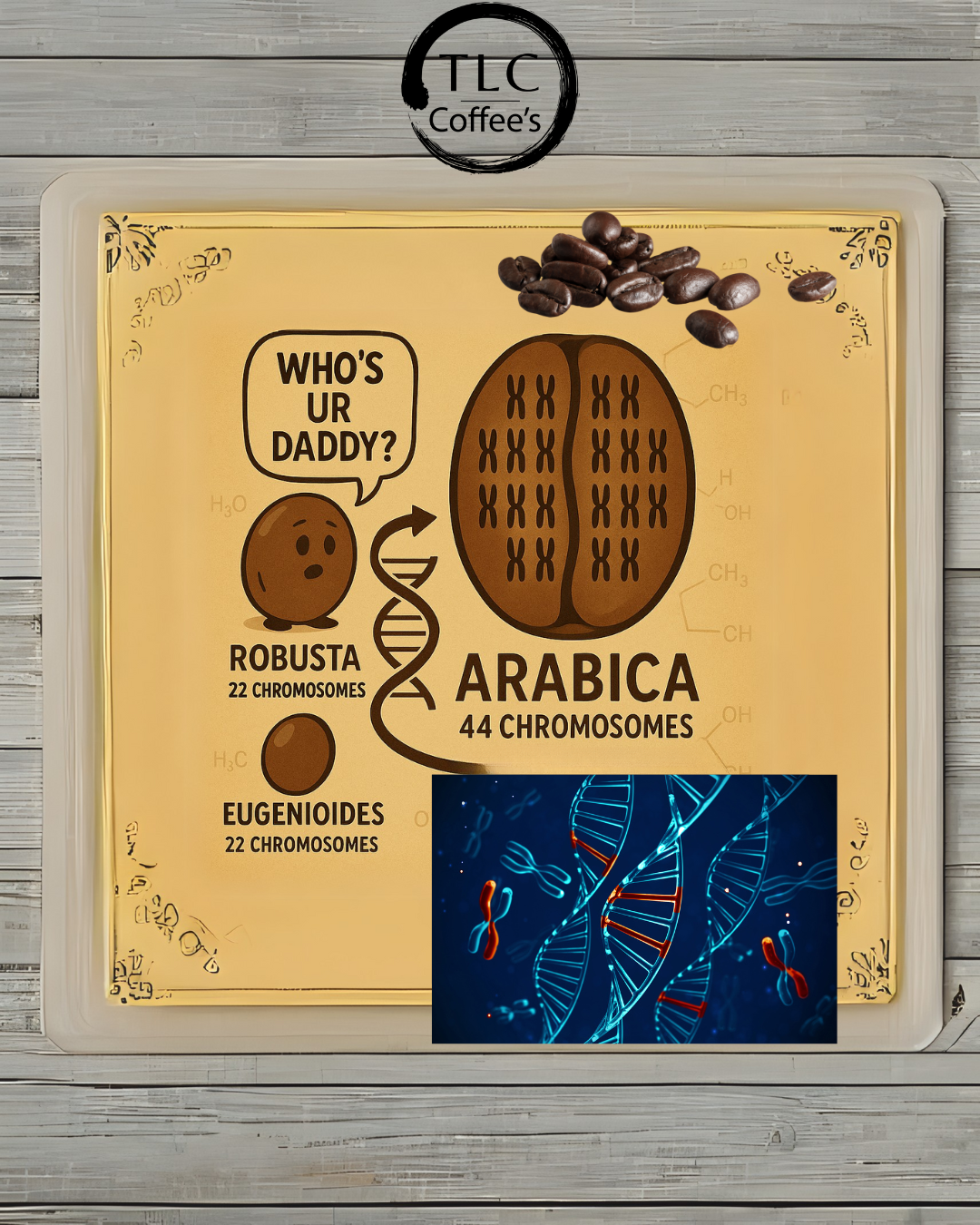
Coffee isn’t just geography; it’s genetics, chance, and a tiny chromosome hiccup that changed breakfast forever. So next time someone boasts, “Do you know who my dad is?” remember: even your latte had to ask that question. let’s answer the question.
1. Introduction
When customers ask us about “coffee origins,” they usually mean terroir—Ethiopia, Colombia, Chikkamagaluru. Scientists, however, start several layers higher: Kingdom → Family → Genus → Species → Variety. All drinkable coffee comes from the plant family Rubiaceae and the genus Coffea, which boasts 120 + species. Only four regularly reach your mug:
| Species | Alias | Taste Snapshot |
|---|---|---|
| C. arabica | Arabica | Sweet, floral, delicate |
| C. canephora | Robusta | Bold, earthy, high-caffeine |
| C. liberica | Liberica | Smoky, jackfruit-like finish |
| C. excelsa | Excelsa | Tart, winey, complex |
(Search engines, note these: best filter coffee in Mangalore, Arabica vs Robusta, TLC Coffees single origin.)
2. Materials & Methods (a.k.a. The Geeky Bit)
All Coffea species are diploid, carrying 22 chromosomes (11 pairs)—except one. When researchers karyotyped C. arabica, they found 44 chromosomes: a tetraploid with two whole genomes instead of one.¹ How? Sometime in the misty highlands of Ethiopia or South-Sudan, pollen from Coffea canephora (Robusta) met the blossoms of the delicate Coffea eugenioides. The resulting seedling doubled rather than halved its chromosomes, producing a viable hybrid we now call Arabica.
(1) Geleta et al., 2012, Genetic Diversity of Arabica Coffee; Sage, 2017, Re:Co Symposium.
3. Results
3.1 A Surprise in the Gene Pool
Arabica’s 44-chromosome miracle endowed it with:
- Refined sugars & aromatics (thank you, C. eugenioides)
- Moderate caffeine kick & disease resistance (cheers, Robusta)
- Self-fertility, which allowed it to spread quickly across the tropics.
3.2 The Reputation Plot Twist
For decades Robusta was dismissed as “the ugly sister of Arabica.” Then DNA tests revealed it was, in fact, one of the parents. Or, as coffee guru James Hoffmann puts it, “Robustas were always thought of as the ugly sister of Arabica—until we discovered Robusta is actually one of the parents.” Indian Coffee Culture
Cue collective industry blush.
4. Discussion
4.1 Can We Re-create the Magic?
Scientists have crossed Arabica and Robusta in lab and field, producing the hybrid “Timor” (nicknamed Arabusta). Flavour remains inconsistent, but climate resilience is promising. Expect more research as global warming squeezes high-altitude farms.
4.2 Why It Matters at TLC
- Flavour flights – Our Mysore Blend marries Arabica elegance with a measured Robusta kick, honouring both ancestral lines.
- Sustainability – We partner with estates trialling new Coffee selections to future-proof your morning brew.
- Education – Every filter coffee we serve in Mangalore comes with a side of science—because knowing the story makes the cup taste better.
Brew & Brew Again
Curious to taste the family tree? Visit TLC Art Café for a side-by-side pour-over of Arabica, Robusta, and our signature blend—or order freshly roasted beans online. Your palate (and inner science nerd) will thank you.
References (abridged & reader-friendly)
- Geleta, M. et al. (2012). Genetic Diversity of Arabica Coffee. BMC Plant Biology.
- Sage, E. (2017). Re:Co Symposium presentation on Coffea species diversity.
- Hoffmann, J. (2014). The World Atlas of Coffee. (Quote referenced above.) Indian Coffee Culture


