

It begins, as many Indian stories do, with a monk, a journey, and a seed.
☕ The Monk Who Crossed Oceans
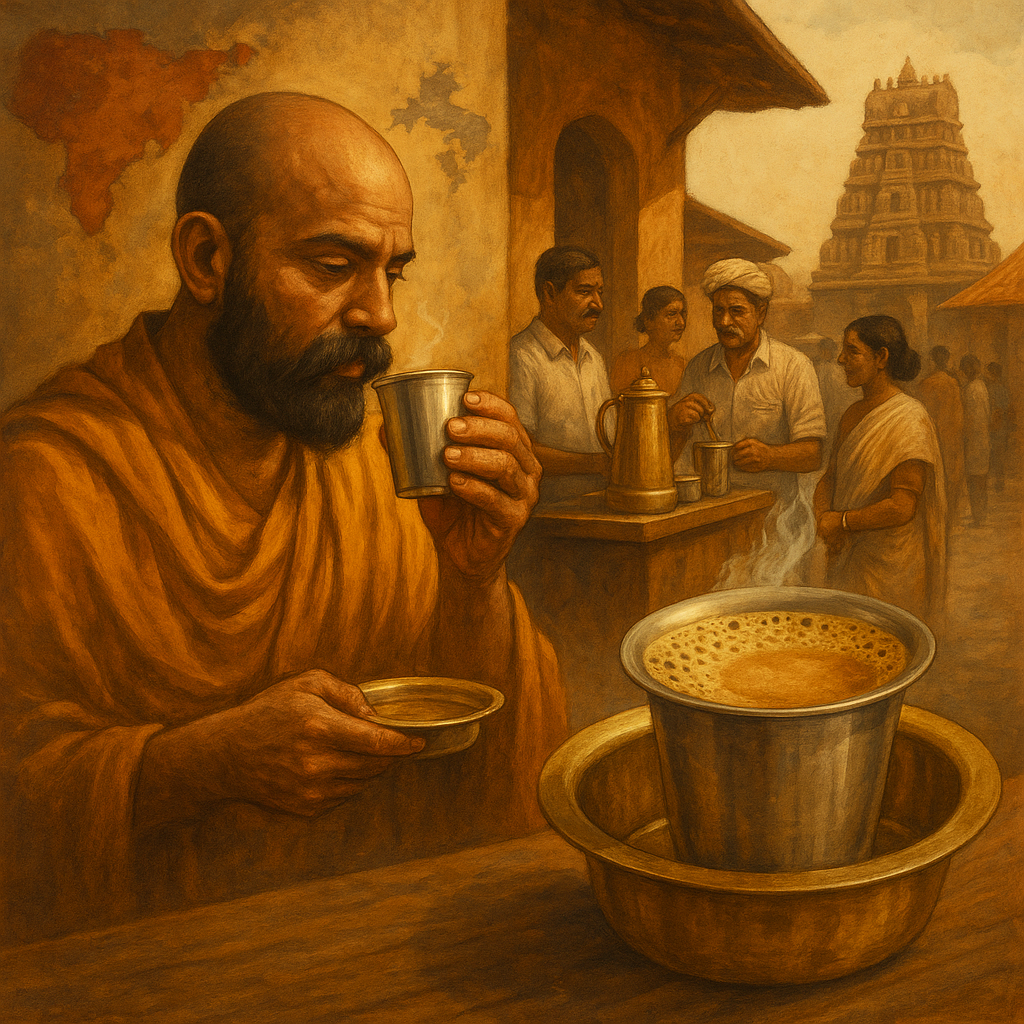
In the 17th century, Baba Budan, a Sufi saint from Karnataka, smuggled seven coffee beans from the port of Mocha in Yemen. These beans were illegal to export—Arab traders guarded their monopoly fiercely. But Baba Budan wasn’t merely importing a drink; he was planting the seeds of a revolution.
He returned home and sowed the beans on the lush slopes of Chikmagalur’s Baba Budangiri Hills. These hills, now the heart of India’s coffee culture, gave birth to what we now know as Indian filter coffee.
But filter coffee as we know it didn’t come alive just then.
It would take colonization, war, scarcity, and caste to shape this drink into the democratic brew we know and love today.
🇫🇷 A French Connection: The Chicory Twist
Fast-forward to World War II. Across the globe, in war-torn France, coffee became scarce. In desperation, the French began mixing roasted chicory root with coffee to stretch their dwindling supplies. Chicory was earthy, slightly bitter, and oddly addictive. The habit stuck.
Meanwhile, in India, the British had brought their love for tea. Coffee remained the drink of the South—especially Tamil Nadu and Karnataka. But it was expensive. Enter chicory.
South Indian households began adopting this clever French practice, blending chicory with coffee to make it affordable, giving birth to a unique taste—smooth, bold, slightly nutty, and comfortingly bitter.
That’s how filter coffee, or degree coffee, came into being: a necessity-born innovation that became a cultural obsession.
🔄 The Coffee That Bridged Castes
Traditionally, coffee was a Brahminical affair—served in silver tumblers in upper-caste homes. But as India modernized and coffee became more accessible, thanks to the chicory blend and affordable stainless steel tumblers, it seeped through the social fabric.
By the 20th century, filter coffee was being brewed not just in homes, but in roadside kaapi stalls, shared among people from all walks of life—caste, class, and creed.
Steel tumblers replaced silver ones. Conversations spilled from upper-class kitchens into bustling darshinis and cafes. Coffee wasn’t just a beverage—it was a social equalizer.
It’s no exaggeration to say that filter coffee, with its irresistible aroma and frothy top, did something politics could not—it created a common ground.
🏠 TLC Café’s Filter Coffee: A Taste of History
At TLC Art Café, our filter coffee pays homage to this rich legacy. We don’t just serve a cup—we serve a story.
Our Mysore Blend brings together the boldness of Mysore Robusta and the elegance of Coorg Arabica, slow-roasted and finely ground to suit traditional South Indian brass filters. We keep the chicory ratio just right—for that authentic punch, without the bitterness overload.
✨ Filter Coffee 250g – ₹299
✨ 100g Trial Pack – ₹140
Brew it slow. Let the decoction drip. Add hot milk, a dash of sugar, and serve in a steel tumbler with a dabarah. Let the scent take you back centuries.
📈 Why People Are Searching for Filter Coffee Today
- What makes South Indian filter coffee unique?
- Is filter coffee healthier than instant coffee?
- Where can I buy authentic Indian filter coffee blends?
- How to brew filter coffee at home?
If you’ve been asking these questions, you’re not alone. Filter coffee is trending—and it’s not just nostalgia. It’s comfort. It’s ritual. It’s resistance. And it’s delicious.
❤️ Final Sip
Filter coffee is more than a drink. It’s a story brewed from rebellion, refined by war, and unified through community. Every cup holds centuries of adaptation, resistance, and togetherness.
So next time you take a sip, know this: you’re not just drinking coffee—
you’re tasting Indian history.


